Flying the Flag for Inclusion (by accident almost…)
Hidden Inclusion Is Everywhere
The International Code of Signals
We often think of inclusion as a modern design concern — something developed in the last decade or two.
But many systems were already inclusive long before the term existed, simply because they had to work under real-world conditions.
One of the best examples is the International Code of Signals (ICS).
What is the ICS?
The International Code of Signals is a global communication system used by ships at sea.
Long before radio communication was reliable, vessels relied on flags, lights, shapes, and sound signals to communicate essential information — between ships, between ship and shore, and during emergencies.
The modern ICS alphabet was standardised in the mid-19th century, refined by the British Board of Trade, and later internationalised. The goal was simple:
Every ship in the world, regardless of language, must be able to understand the same messages.
How the system works
The ICS includes:
26 alphabetical flags (A–Z)
10 numeral pennants (0–9)
3 repeaters (to duplicate letters in hoists)
special flags for signalling conditions
Each flag is visually distinct and also carries a meaning beyond its letter.
Examples:
A – Alfa: “I have a diver down; keep well clear.”
B – Bravo: “I am carrying dangerous cargo.”
O – Oscar: “Man overboard.”
V – Victor: “I require assistance.”
It is an entire international language designed to cut through uncertainty, weather, and linguistic barriers.
Victor means “I require assistance” or ” Ich benötige Hilfe” or “Je demande assistance” or “Ég þarfnast aðstoðar”…you get the idea. In an emergency even an old times sailor (who historically often couldn’t write or read, as opposed to officers) could raise a “I require medical assistance” flag (Whiskey) with know how to spell any of that.
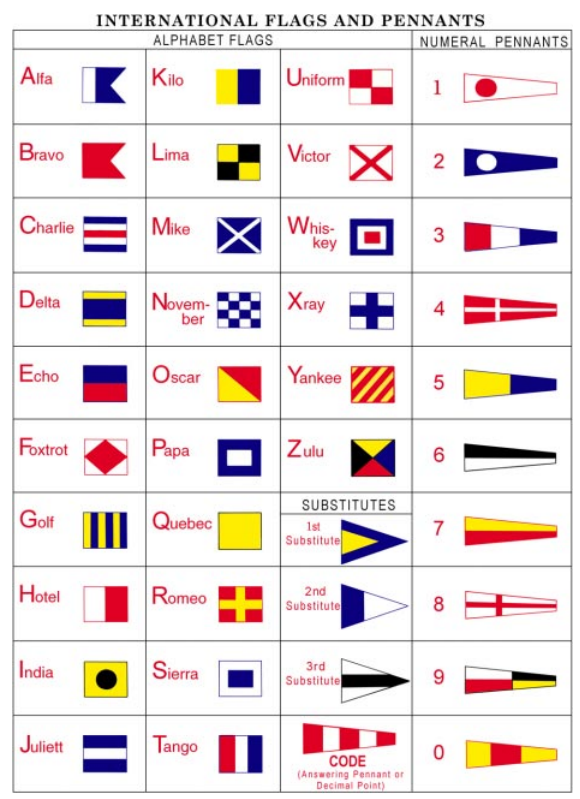
From the INTERNATIONAL CODE OF SIGNALS UNITED STATES EDITION 1969 Edition (Revised 2003)
Where inclusion comes in
The ICS had to work:
in fog
in storms
at long distances
with faded materials
across languages
across levels of literacy
Systems that must function under these conditions cannot rely on ideal users or perfect perception.
And this is where something interesting happens.
Designed for reality, not perfection
Historically, maritime crews were overwhelmingly male — and around 8% of men have some form of colour-blindness.
For most of history, there was no colour-vision testing. You simply took whoever could work a deck, haul a line, or stand a watch.
(Or, in earlier Royal Navy terms: anyone drunk enough to sign three Xs and not run away.)
If the signalling system had relied on precise colour perception, it would have failed immediately.
So it didn’t.
Why the ICS is colour-blind inclusive
Even though the flags use colour, they are not defined by colour alone.
They are recognisable through:
horizontal vs. vertical stripes
diagonal divisions
chequered patterns
central blocks
strong contrast
distinctive proportions
This means that someone with red–green colour-blindness can reliably distinguish between flags based on pattern, not colour.
In other words:
The system works in greyscale.
Inclusion by necessity
No one set out to make the ICS “accessible” in the modern sense.
They set out to make it:
reliable
unambiguous
usable under pressure
And in doing so, they created a system that is highly inclusive.
This is universal design before it had a name.
What this tells us
The ICS shows something fundamental:
When systems are designed to work under pressure, uncertainty, and real-world conditions, they often become more inclusive.
Accessibility is not always an added feature.
It is often the natural result of designing for:
variability
failure
imperfect users
non-ideal conditions
Everyone wins
Inclusive design does not create burden.
It creates clarity.
Even for someone with perfect colour vision, the ICS is easier to read because it relies on multiple signals, not just one.
Inclusion doesn’t make things harder for others.
It makes systems:
more robust
more reliable
easier to use
safer
for everyone.
Hidden inclusion is everywhere
Sometimes inclusion is not new.
Sometimes it is already built into the systems that had to work — quietly, effectively, and without being labelled as such.
We just haven’t been calling it by its name.